
Cricket injuries
Back stress fractures in fast bowlers
What a lumbar bone stress injury is, why young quicks get it, how it is managed in phases, and what recovery looks like. A plain guide.
Before you read on
This is general information about a cricket injury, not a diagnosis of yours or your child's. Back pain in a young bowler should be assessed in person. If you have symptoms, see a physiotherapist or doctor for an assessment specific to you.
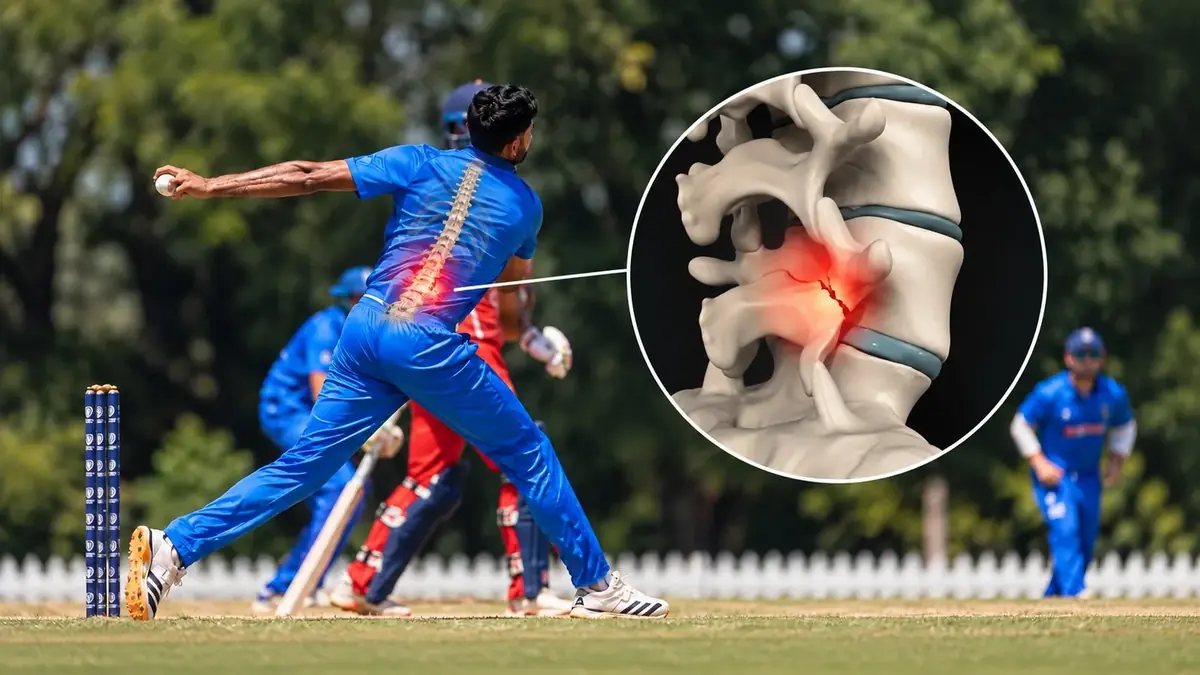
If you are a fast bowler, or the parent of one, "stress fracture in the back" is a phrase you do not want to hear. It sounds like the end of a season, or worse. The good news is that most of these injuries heal well when they are caught early and managed properly. The bad news is that they are common, they are easy to miss in the early stages, and the instinct to push through is the wrong one.
This guide covers what the injury is, why young quicks get it, and what a sensible recovery looks like. If there is back pain now, the last sections tell you what to do about it.
What "lumbar bone stress" means
The technical name is lumbar bone stress injury, or LBSI. It affects a small part of the vertebra in the lower back called the pars interarticularis. Fast bowling loads this exact spot hard, because the delivery stride combines extension, side-bend and rotation at speed, over and over.
The important thing to understand is that this is a continuum, not a single event. It runs from a bone stress reaction, where the bone is irritated and swollen but intact, through to a stress fracture, where a crack has developed. Caught at the reaction end, it tends to heal quickly and completely. Left to progress to a full fracture, it takes longer and is more likely to leave a lasting defect.
The practical point
Early back pain in a bowler is not something to bowl through for a few more weeks to see if it settles. The earlier it is caught on the continuum, the shorter and cleaner the recovery.
Why young fast bowlers get it
This injury has a clear demographic. It overwhelmingly affects teenage and young-adult bowlers rather than older ones. Australian Cricket research puts the rate at roughly one in five to one in three junior pace bowlers developing a lumbar bone stress injury each season. That is not a rare freak event. It is one of the defining injuries of youth fast bowling.
The riskiest window is puberty. The research points to the roughly 18 months after a young athlete's biggest growth spurt as the peak danger period. The reason is a mismatch: bones grow long before they grow strong. A teenager who has shot up in height is generating adult-sized forces through a spine that has not caught up in bone strength.
A few other things stack the odds:
- Bowling too often, with too little recovery. The research is clear that frequency of bowling (sessions per week, days without a break) is a stronger risk factor than the raw number of balls bowled.
- Being tall and fast. Bowlers who are taller and quicker than their peers put more through the spine and need more recovery, not less.
- A mixed bowling action, which twists the shoulders and hips out of alignment and concentrates load on one side.
- Sudden spikes in load, classically a carnival or a run of matches after a quiet stretch.
The counterintuitive bit: under-bowling is also a risk
Here the picture gets more interesting than the usual "rest more" message. Recent Australian research tracking junior bowlers across a season found that most were bowling well below the recommended guidelines, with long gaps of no bowling at all. Yet the injury rate stayed high.
The likely explanation is that chronically under-bowled bones never get conditioned to the load. They stay unprepared, so when a carnival or a busy fortnight arrives, the spike hits a spine that has no resilience built up. The spike is dangerous partly because of the quiet period before it.
The goal is not to bowl as little as possible. It is to bowl consistently enough that the bone is prepared, while avoiding the sudden jumps in load that cause injury.
This is why load management is a skill, not only a brake. Too much, too soon is a problem. So is too little for too long, followed by a sudden return.
How it gets diagnosed
The typical picture is lower back pain on one side that gets worse with bowling and eases with rest, sometimes with pain on arching backwards. A physiotherapist assesses the pattern, but imaging is what confirms it.
Plain X-rays are not good enough here. They often look normal while a stress reaction or early fracture is already present. MRI is the standard, because it picks up the bone swelling (marrow oedema) that signals stress well before a crack is visible. That means the injury is caught at the reaction stage, which is when management works best.
How recovery works
Modern management of a bowler's back is built around one central idea: give the bone the conditions to heal, then rebuild load in a planned, staged way. It is usually described in four phases.
- Unload and protect. Stop bowling. This is the non-negotiable part. The aim is to take the repetitive load off the healing bone. This phase is about calming the injury, not sitting still doing nothing.
- Reload gradually. Rebuild the foundation with a structured strength program: lumbopelvic control, glutes, trunk and legs. The body keeps training in every way that does not stress the healing site.
- Return to bowling. Bowling comes back in careful, progressive steps, starting at low intensity and volume and building against clear targets, not against the calendar.
- Return to competition. Full match bowling resumes once the bowler has met the criteria along the way and tolerates the loads the game demands.
The timeframe surprises most families. If the plan is symptom-based (bowl again once it stops hurting), the figure quoted is often around six to ten weeks. But bone healing lags well behind symptoms. True bony healing on MRI takes closer to three to six months, and Cricket Australia's own figures cite four to twelve months from injury to a full return in many cases. Those are ranges from the research, not a date for any one bowler.
Why the wait is worth it
Chasing symptom relief and returning early risks the bone healing as a fibrous union rather than solid bone. That leaves a defect that predisposes the bowler to the next stress injury. Healing it properly the first time protects a bowling career, not only a season.
What this means if you are a bowler or a parent
- Take early back pain seriously. Persistent one-sided lower back pain in a young bowler needs an assessment, not a wait-and-see.
- Respect the growth-spurt window. The 18 months after a big growth spurt is when to be most conservative with bowling frequency.
- Manage frequency and recovery, not only ball count. Days between bowling sessions matter more than most people realise. Cricket Australia's junior guidelines are a good starting framework.
- Do not confuse rest with a plan. Complete rest heals the bone but leaves the bowler weaker and unprepared. Good rehab keeps building everything else while the bone recovers.
- Trust the criteria, not the calendar. A return built on hitting strength and loading targets is safer than one built on a date circled before a tournament.
Bowlers' backs have a reputation for ending careers. They earned it in an era before MRI, when injuries were missed, bowled through, and left to become permanent defects. Managed early and properly today, the outlook is good. The hard part is patience.
Where I fit
If you want a bowler's back assessed, or a return-to-bowling plan built properly, that is the work I do. In Melbourne that is an appointment in Richmond. Elsewhere it starts by video. For more, read back pain in fast bowlers and back pain in junior fast bowlers.
References
- Cricket Australia. Junior Pace Bowling Workload Guidelines. Incidence of lumbar bone stress injury in junior pace bowlers, return-to-play timeframes and the workload rules by age group.
- Keylock L, Alway P, Felton P, McCaig S, Brooke-Wavell K, King M, Peirce N. Lumbar bone stress injuries and risk factors in adolescent cricket fast bowlers. Journal of Sports Sciences, 2022;40(12):1336 to 1342. doi:10.1080/02640414.2022.2080161
- Are junior fast bowlers under-bowled? A seasonal bowling workload comparison with Cricket Australia guidelines. Journal of Science and Medicine in Sport, 2025. Full text
Worried about a bowler's back?
Book a one-on-one assessment in Richmond, or send an enquiry first.